On Coding
Jon Reades - j.reades@ucl.ac.uk
12th October 2026
According to the BBC & Google, programming is about:
- Decomposition: breaking down a complex problem or system into smaller, more manageable parts.
- Pattern recognition: looking for similarities among and within problems.
- Abstraction: focusing on the important information only, ignoring irrelevant detail.
- Algorithms: developing a step-by-step solution to the problem, or the rules to follow to solve the problem.
What About Computational Thinking?
Computational thinking is not thinking like a Computer Scientist. It is about recognising how to code can help us to understand, and manipulate, the world.
Key Features
Aspects of computational thinking include:
- Recognising how one problem connects to other problems.
- Recognising when and how to make things simpler and faster
- Recognising how different ways of tackling a problem gives you power to tackle new problems.
See this keynote by Lorena Barba (2014); esp. from 52:00 onwards.
Why Are These Virtues?
According to Larry Wall the three virtues of the programmer are:
- Laziness
- Impatience
- Hubris
These are not to be taken literally (see Larry Wall’s “Three Virtues of a Programmer” are Utter Bull💩).
Four Quotes to Remember
- Computers make very fast, very accurate mistakes.
- A computer program does what you tell it to do, not what you want it to do.
- Only half of programming is coding. The other 90% is debugging.
- Weeks of coding can save you hours of planning.
And One More…
> Experience is the name everyone gives to their mistakes.
Oscar Wilde
Algorithm as Recipe…
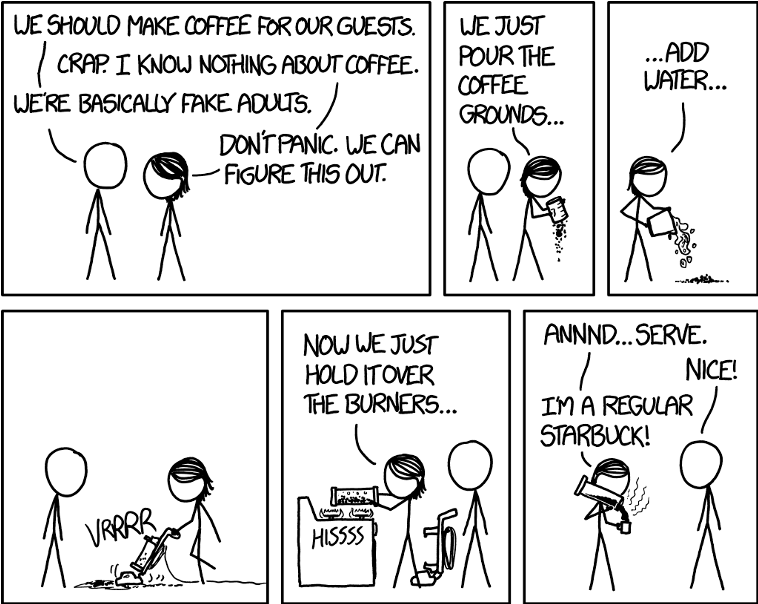
Following a Recipe is Easy, Right?
Calculating the Mean
Given these numbers, what’s the average?
1, 4, 7, 6, 4, 2As a Recipe
- Take a list of numbers
- Start a count of numbers in the list at 0
- Start a sum of numbers in the list at 0
- Take a number from the list:
- Add 1 to the count
- Add the value of the number to the sum
- Repeat step #4 until no numbers are left in the list.
- Divide the sum by the count
- Report this number back to the user
As Python
Why We Still Haven’t ‘Solved It’
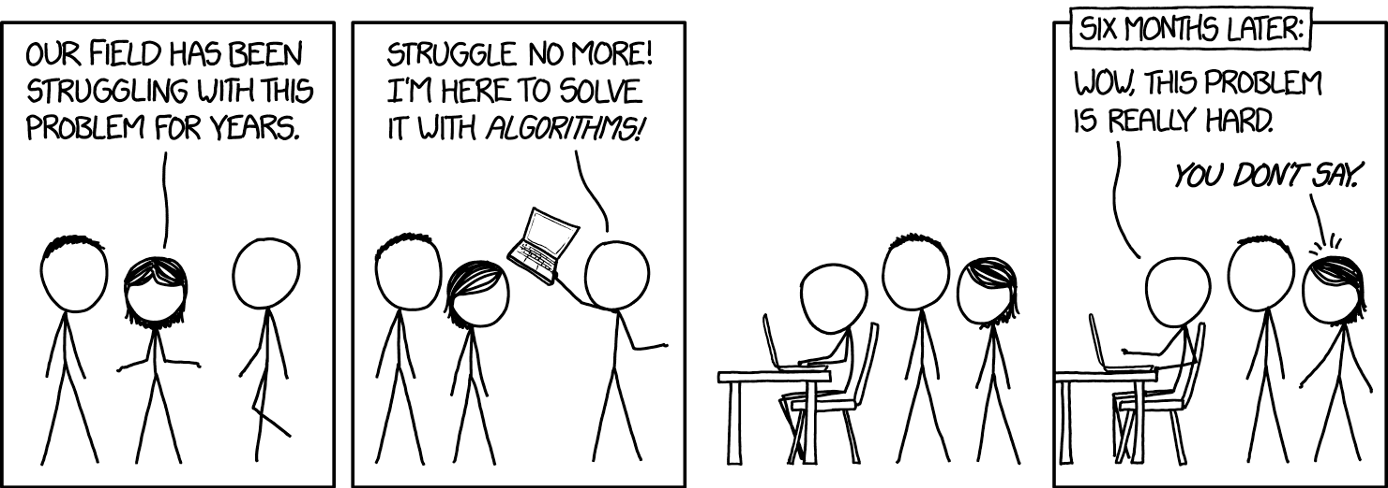
Computers are good at:
- Doing exactly what they are told.
- Doing it over and over indefinitely.
Computers are not good at:
- Solving problems that you can’t define.
- Creating new knowledge.
Languages
Computer languages come with all of the ‘baggage’ of human languages; they have:
- A vocabulary (reserved words)
- A grammar (syntax)
- Rules about the kinds of things you can say (grammar)
- Styles and idiosyncrasies all their own (history)
In this module we will use the Python programming language. We could also teach this same content in R.
Python
R
Finally: Style
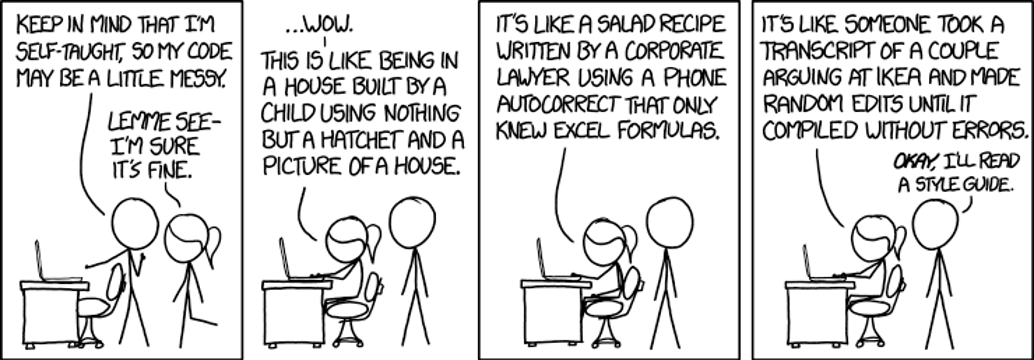
Although all programmers develop their own style (see: writing in any language), Python encourages coders to use a consistent style so that others can pick up your code and make sense of what’s going on (see: comments!).
Two useful resources:
> It’s okay to figure out murder mysteries, but you shouldn’t need to figure out code. You should be able to read it.
Steve McConnell
Source: xkcd
Science is what we understand well enough to explain to a computer. Art is everything else we do.
Donald Knuth, Things a Computer Scientist Rarely Talks About